AI phone call assistants are transforming how businesses handle calls, from answering common questions to routing complex inquiries and booking appointments. Modern approaches to customer support now include virtual agent assist technologies, which allow customers to get fast, natural, and personalized help 24/7 without waiting on hold or navigating complicated menus. Companies exploring advanced computing solutions from FlashMob Computing often find these systems integrate seamlessly with modern communication tools.
This guide breaks down what an AI phone call assistant is, how it works, and how you can use it to improve customer experience, reduce costs, and support your team. Many businesses also look into supercomputer platforms for enterprise tasks to handle high call volumes efficiently. Using insights from Marketing for Customers’ strategies on personalized engagement, you can ensure each caller feels valued while automating routine processes.
For teams aiming to optimize every customer interaction, Marketing Runners’ tips for customer-centric campaigns show how combining automation with human touch drives loyalty. Financially-minded organizations can explore top financial resources for scaling contact centers, ensuring your AI phone call assistant aligns with budget and ROI goals. Finally, adopting long-tail approaches to AI-driven phone support can streamline operations and reduce response times, creating a modern, efficient support system your customers will appreciate.
Top 10 AI Contact Center Solutions for Optimized Customer Support
Looking for the best AI contact center solutions? AI phone call assistants are transforming how companies manage calls, improve customer experience, and streamline operations. Here’s a list of the top 10 platforms you should consider.
1. Bright Pattern
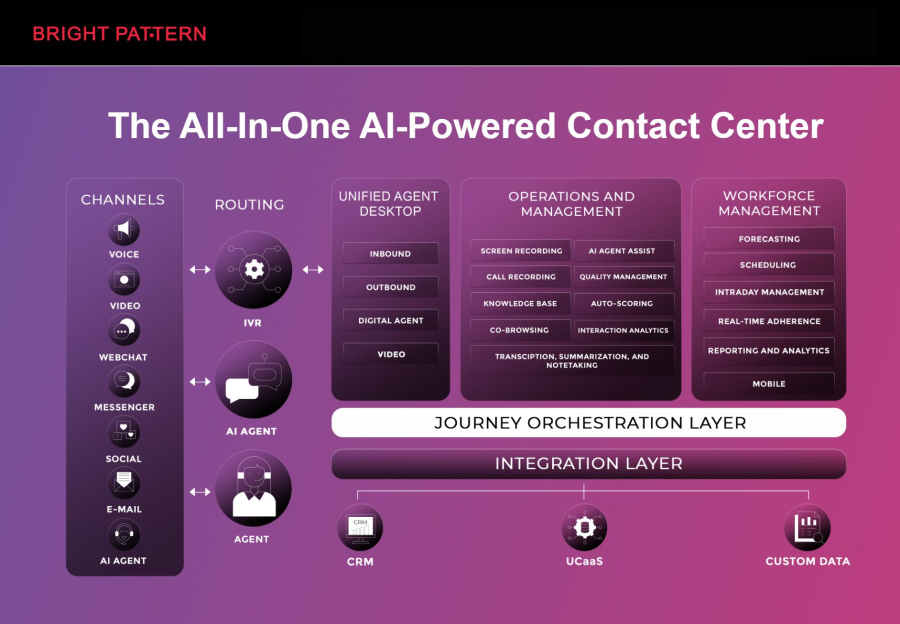
Bright Pattern is a leading AI contact center platform that enables businesses to deliver seamless customer experiences. With AI phone call assistant capabilities, Bright Pattern helps companies automate routine inquiries while allowing human agents to focus on complex interactions.
Key features:
- Omnichannel support across phone, chat, email, and social media
- AI-powered call routing and virtual agent assist
- Advanced analytics for performance optimization
- Cloud-based architecture for scalable operations
- Integration with CRM and business tools for personalized customer engagement
Bright Pattern’s AI solutions allow businesses to reduce response times, cut operational costs, and provide 24/7 support without sacrificing quality.

2. Five9
Five9 offers cloud contact center software with AI capabilities that assist agents in managing high volumes of customer interactions efficiently. Their platform includes intelligent call routing, real-time transcription, and analytics to optimize agent performance.
3. Genesys Cloud
Genesys Cloud provides AI-driven customer engagement solutions that enable businesses to deliver personalized experiences. Features include predictive routing, automated workflows, and virtual agent assist to reduce wait times and improve satisfaction.
4. Talkdesk
Talkdesk offers AI contact center software that combines automation with human agent support. Its AI tools include virtual agents for handling repetitive tasks, call transcription, and sentiment analysis to improve customer interactions.
5. 8x8 Contact Center
8x8 provides cloud contact center solutions that incorporate AI to enhance call handling and agent efficiency. Features include automated call distribution, AI phone call assistants, and real-time analytics for monitoring performance.
6. NICE inContact
NICE inContact CXone leverages AI to optimize customer journeys. With intelligent virtual agents, predictive analytics, and omnichannel support, it helps businesses scale operations while maintaining high service quality.
7. RingCentral Contact Center
RingCentral offers a cloud contact center platform that integrates AI phone call assistants to support automated responses, call routing, and performance reporting, helping teams handle calls more effectively.
8. Avaya OneCloud
Avaya OneCloud provides AI-powered contact center solutions, including virtual agents, speech analytics, and automated workflows. These tools streamline call handling and improve customer experience.
9. Cisco Contact Center
Cisco’s AI-driven contact center solutions focus on enhancing agent productivity and customer satisfaction. Their platform includes virtual assistants, intelligent call routing, and integration with enterprise systems.
10. Zendesk Talk
Zendesk Talk combines AI phone call assistant functionality with omnichannel support. Its tools allow for automated call handling, improved response times, and seamless integration with CRM platforms.
What Is an AI Phone Call Assistant?
An AI phone call assistant is a software system that uses artificial intelligence to understand and respond to callers by voice. It can handle many of the same tasks a human agent would, such as answering questions, collecting information, routing calls, or completing simple actions.
These assistants typically sit between your phone system and your customer, listening to what the caller says, interpreting the intent, and then responding with a natural-sounding voice. They can work on inbound calls, outbound calls, or both.
Core capabilities of an AI phone call assistant
- Understanding speech— Converts spoken words into text and interprets meaning.
- Speaking naturally— Responds with a realistic, human-like voice.
- Following conversation flow— Remembers context within a call and manages turn-taking.
- Executing tasks— Looks up information, submits forms, or updates systems while on the call.
- Routing intelligently— Transfers callers to the right human agent when needed, along with relevant context.
How AI Phone Call Assistants Work
While the experience feels simple to the caller, several technologies work together behind the scenes.
1. Speech recognition (listening)
The assistant usesautomatic speech recognitionto convert what a caller says into text. Modern systems can handle different accents, speaking speeds, and background noise with increasing accuracy.
2. Natural language understanding (interpreting)
Once the speech is transcribed,natural language understandingidentifies what the caller wants to achieve — theirintent— and extracts key details like names, dates, order numbers, or locations.
3. Business logic and integrations (acting)
The assistant connects with your existing systems to perform actions. This may include:
- Looking up customer records in a CRM.
- Checking order or delivery status.
- Booking, rescheduling, or canceling appointments.
- Creating tickets in a helpdesk or support tool.
- Triggering workflows, such as sending a confirmation email or SMS.
4. Natural language generation and text-to-speech (responding)
Based on the intent and results from your systems, the assistant generates a suitable response and converts it into natural-sounding speech. Advanced systems can adjust tone, speed, and phrasing to match your brand voice.
Key Benefits of an AI Phone Call Assistant
When implemented thoughtfully, AI phone call assistants deliver tangible benefits for both your customers and your team.
1. Faster response times
- No waiting on hold— AI can answer immediately, even during peak times.
- Instant answers to simple questionslike business hours, order status, or account balance.
- Smart triagesends complex issues to the right agent without bouncing the caller around.
2. 24 / 7 availability
An AI assistant never sleeps. It can:
- Handle after-hours calls and weekend inquiries.
- Capture leads or appointment requests outside business hours.
- Provide basic support when your team is unavailable or overloaded.
3. Reduced workloads for human agents
AI phone call assistants shine at repetitive, high-volume tasks. They can:
- Answer frequently asked questions.
- Gather caller details before passing the call to an agent.
- Handle routine updates, such as address changes or simple account queries.
This frees your human team to focus on higher-value conversations that require empathy, negotiation, or in-depth problem solving.
4. Consistent, on-brand service
AI will always use the latest approved scripts, disclaimers, and product details. Benefits include:
- Consistencyacross every call, no matter who is calling or when.
- Reduced training timefor new agents, who can rely on AI to handle baseline inquiries.
- Centralized updates— change a policy in one place and every AI call reflects it.
5. Cost efficiencies and scalability
An AI phone call assistant can handle many calls simultaneously, which helps you:
- Scale call volume without hiring in direct proportion.
- Smooth out seasonal spikes or campaign-driven surges.
- Offer extended coverage hours without staffing extra shifts.
6. Better data and call insights
Because AI handles conversations digitally, it can automatically capture call data:
- Common questions and topics.
- Reasons for calls and call outcomes.
- Average handling time and transfer rates.
- Keywords that signal churn risk or sales opportunities.
These insights support better decisions in product, marketing, operations, and customer success.
Top Use Cases for AI Phone Call Assistants
AI phone call assistants can be tailored to many roles and industries. Below are some of the most impactful scenarios.
Customer service and support
- Answer common support questions (password resets, order tracking, store hours).
- Provide self-service troubleshooting steps before escalating.
- Open and categorize support tickets with full context.
Sales and lead qualification
- Answer pre-sales questions about pricing, availability, or product features.
- Qualify inbound leads by asking key questions.
- Route hot leads to the right salesperson with a summary of the conversation.
Appointment-based businesses
- Book, reschedule, or cancel appointments.
- Send automated reminders via SMS or email (through connected systems).
- Fill last-minute openings by calling waitlists or previous inquiries.
Logistics, delivery, and field services
- Provide real-time order or delivery status.
- Confirm addresses or delivery windows.
- Collect feedback or proof-of-service follow-up information.
Healthcare and wellness
(Always ensuring compliance with applicable regulations and privacy standards.)
- Handle routine appointment scheduling and reminders.
- Answer non-diagnostic questions about office hours, location, or prep instructions.
- Route urgent calls to on-call professionals quickly.
Financial services
(With strong authentication and security controls.)
- Provide general information on products, rates, or hours.
- Help with balance inquiries or simple account updates, when allowed.
- Pre-qualify callers for specific financial products and route to specialists.
Essential Features to Look For
Not all AI phone call assistants are the same. When choosing or designing a solution, pay attention to these capabilities.
1. Natural and adaptable voice
- Multiple voice options that sound clear and human-like.
- Adjustable tone, speed, and style to match your brand.
- Support for different languages or regional accents if needed.
2. Strong understanding of real conversations
- Ability to handle interruptions, corrections, and follow-up questions.
- Support for more natural phrases instead of rigid menu choices.
- Recognition of key phrases specific to your industry.
3. Deep integrations with your systems
The real power comes when AI is connected to your existing tools. Look for easy integration with:
- Customer relationship management (CRM) platforms.
- Helpdesk and ticketing systems.
- Appointment or booking systems.
- Order management or inventory systems.
- Authentication and identity management tools, where sensitive data is involved.
4. Smart routing and escalation
- Clear rules for when to transfer a call to a human.
- Warm handoffs where the agent sees notes or a call summary.
- Prioritization logic based on customer type, urgency, or topic.
5. Analytics and reporting
- Dashboards showing call volumes, completion rates, and common intents.
- Transcripts or summaries for quality review.
- Metrics for containment (calls resolved fully by AI) and escalation patterns.
6. Security and compliance controls
Depending on your industry, ensure your AI assistant supports:
- Encryption in transit and at rest.
- Access controls and audit logs.
- Data retention policies aligned with your legal requirements.
- Options to avoid storing sensitive data from calls, when needed.
AI Phone Call Assistant vs. Traditional IVR
Many businesses already use interactive voice response (IVR) systems with numbered menus. AI assistants go beyond IVR to create more natural, flexible experiences.
Aspect | Traditional IVR | AI Phone Call Assistant |
Interaction style | Press 1 / 2 / 3 menus | Natural conversation in plain language |
Flexibility | Rigid, pre-set options | Understands varied phrases and intents |
Personalization | Limited | Can use CRM data to tailor responses |
Complex tasks | Challenging to build and maintain | Can orchestrate multi-step workflows |
Scalability | Requires careful menu design | Adapts as you add new intents and use cases |
How to Implement an AI Phone Call Assistant
A successful deployment is as much about planning and process as it is about technology.
Step 1: Define clear goals
Start with specific, measurable outcomes. For example:
- Reduce average hold time by 40%.
- Automate 60% of password reset or order status calls.
- Offer 24 / 7 coverage for appointment booking.
Clear goals help you prioritize features and measure success later.
Step 2: Map your most common call journeys
Analyze existing call logs and talk to your front-line staff to understand:
- Top reasons customers call.
- Questions that follow a predictable script.
- Points where agents repeat the same information many times a day.
These are ideal starting points for AI automation.
Step 3: Design conversation flows
Work with operations, support, and sales leaders to outline how conversations should unfold. Consider:
- What information you must collect at each step.
- How to verify identity, if applicable.
- When to offer self-service and when to route to an agent.
- How to handle confusion, silence, or unclear answers gracefully.
Step 4: Integrate with your tech stack
Connect the AI assistant to the systems it needs to act effectively. Begin with a small number of core integrations, such as:
- Your CRM for customer data.
- Your helpdesk for ticket creation.
- Your scheduling tool for appointments.
You can expand to more advanced workflows as you gain confidence.
Step 5: Pilot with a focused use case
Instead of trying to automate everything at once, choose a high-volume, low-risk scenario, such as:
- Order status inquiries.
- Business hours and location questions.
- Simple appointment booking.
Launch the assistant for a subset of callers, gather feedback, and iterate quickly.
Step 6: Train your team and set expectations
Explain to your staff how the AI assistant works, what it will handle, and when it will transfer calls to them. Emphasize that AI is there tosupportthem, not replace the human elements that customers value.
Step 7: Monitor, optimize, and expand
After launch, continuously review:
- Call transcripts or summaries.
- Drop-off points where callers get confused.
- New question types that appear frequently.
Use this insight to refine your flows, improve responses, and gradually add new tasks for the assistant to handle.
Best Practices for a Positive Caller Experience
Thoughtful design ensures your AI phone call assistant feels helpful, not frustrating.
Be transparent and set expectations
At the start of the call, let people know they are speaking with an AI assistant and what it can do. For example:
You are speaking with our virtual assistant. I can help with order updates, appointments, and common questions, or connect you with a specialist.
Clarity builds trust and reduces confusion.
Always offer a clear path to a human
Even the best AI will not handle every situation. Ensure callers can say something like"speak to an agent"at any time and be transferred smoothly.
Design for real speech, not perfect scripts
People rarely speak in neat, scripted phrases. Prepare for:
- Background noise and interruptions.
- Partial answers or long explanations.
- Slang or informal language.
Test flows with real recordings whenever possible and refine them based on how callers actually speak.
Respect privacy and sensitive topics
If your calls can involve confidential or sensitive information, put clear guardrails in place. For example:
- Limit what the AI can do without proper authentication.
- Avoid asking for unnecessary personal details.
- Offer to transfer to a human agent for sensitive discussions.
Measuring the ROI of Your AI Phone Call Assistant
To demonstrate value, track both operational and experience-focused metrics.
Operational metrics
- Containment rate— Percentage of calls fully handled by AI without human intervention.
- Average handle timefor AI-handled calls vs. human-only calls.
- Reduction in call backlogor missed calls.
- Cost per callbefore and after AI deployment.
Customer experience metrics
- Caller satisfaction scores after AI-assisted calls.
- Net promoter score trends over time.
- Changes in repeat call rates for the same issue.
- Feedback from open text surveys or follow-up interviews.
Employee experience metrics
- Agent satisfaction and engagement scores.
- Turnover or burnout indicators in high-volume roles.
- Time agents spend on complex, value-adding work instead of repetitive calls.
Realistic Expectations: What AI Phone Call Assistants Do Best
AI phone call assistants deliver the greatest value when they are used for:
- High-volume, repetitive tasks with clear rules.
- Structured processes, such as identification, verification, and data capture.
- Quick answers to factual questions with up-to-date information.
- Helping humans work faster by gathering context before transferring the call.
They are less suited to scenarios that demand deep emotional support, complex negotiations, or nuanced judgment without clear guidelines. In those cases, AI is most effective as aco-pilotto human agents, not a replacement.
The Future of AI Phone Call Assistants
AI voice technology is advancing rapidly. Over time, you can expect:
- Even more natural, emotionally aware voices.
- Better understanding of long, unstructured explanations from callers.
- Deeper personalization based on past interactions and preferences.
- Stronger collaboration between AI and human agents during live calls.
Businesses that begin experimenting now will be better positioned to take advantage of these improvements as they emerge.
Conclusion: Turning Every Call into an Opportunity
An AI phone call assistant is far more than a modern answering machine. When implemented strategically, it becomes a powerful extension of your team that:
- Welcomes every caller instantly, day or night.
- Handles routine questions with ease and accuracy.
- Frees your people to focus on high-impact conversations.
- Reveals insights that help you improve products, services, and processes.
By starting with clear goals, focusing on high-value use cases, and designing around real customer needs, you can turn your phone lines into a smarter, more efficient, and more satisfying experience for everyone who calls.
